Entrepreneurialism & Entrepreneurial Development
Innovating and Creating Value for Society
Entrepreneurs, or those with entrepreneurial skills, are highly valued for their ability to create wealth for societies and grow economies. If you aspire to be an entrepreneur, find out how you can develop yourself and acquire the core skills of an entrepreneur while you are still studying.
High EPLs, high EPs, high ELs and high Es score highly for this career type. High Es may have the motivation for only one set of broad skills. They may also lack the motivation to develop the deep expertise in a profession. To be more T-shaped, high Ps, high Ls, high PLs or low EPLs could consider learning more about entrepreneurialism and develop competencies and skills associated with entrepreneurialism.
Entrepreneurialism vs Entrepreneurship
What is Entrepreneurialism? What is Entrepreneurship?
In the EPL career framework, “entrepreneurialism” is about the desire to create products and services of value to fulfill the needs of others or to look for ways to improve things. It includes the idea of “entrepreneurship”. Entrepreneurs are those who are interested in entrepreneurship as a career path. Entrepreneurs are known for creating wealth, starting or owning their own businesses and being their own bosses. But you can be entrepreneurial without being an entrepreneur. Being entrepreneurial means you bring value to an organisation by introducing new ideas, solving problems with the best or most cost-effective methods or re-inventing or improving business processes and products to stay in competition.
How Does Entrepreneurialism Differ From Leadership?
While entrepreneurialism is about creating value to fulfil the needs of others, it is different from leadership which is a process of influencing others to accomplish goals. Entrepreneurs also need leadership competencies (see more under “Leadership Development”) to succeed.
What Does It Take To Be Entrepreneurial?
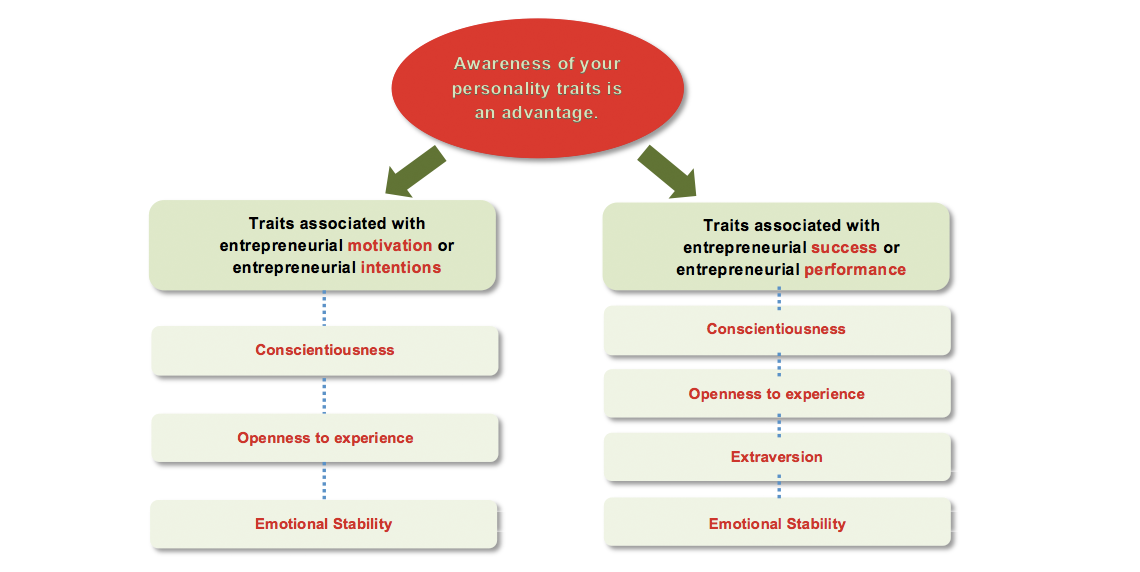
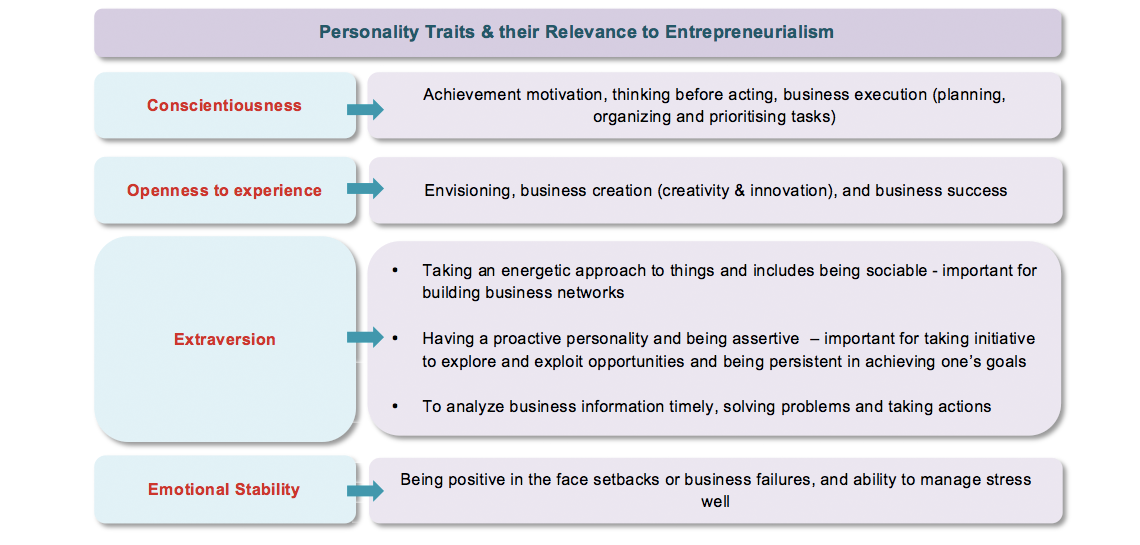
Take a personality test from your institute’s career office to understand your personality strengths. Gauge for yourself and find out if you have what it takes to be a successful entrepreneur. Visit the following websites for free Big-5 personality tests conducted by researchers and to receive a free feedback:
Do Entrepreneurs need to be experts in any area?
Entrepreneurs need not be experts in any area but do need to work with deep expertise (professionals) especially if the ideas come from specialised professions (e.g., medicine and engineering).
Who are Intrapreneurs?
Intrapreneurs are those who work in a large company or corporation, who take busines risks like an entrepreneur. Some useful website are:
Who are Technopreneurs?
Technopreneurs work with technology-based innovations to create and build their business. Techology-driven ideas are core to their business. You might find the following website useful:
Development of Entrepreneurial Skills
What if you do not have the personality traits but you still want to be an entrepreneur? You can develop yourself to be more entrepreneurial at work within your organisation (i.e., an intrapreneur).
Finding Your Entrepreneurial Development Opportunities
Programs offered within your institute. When evaluating the programs, look for content that focus on learning both conceptual knowledge and skills in entrepreneurship. Examples of such courses/programs are “Design Thinking”, “Creative Thinking”, “Systems Thinking” and “Critical Thinking”.
Activities/Events within/outside your institute. Sign up for workshops and join talks and other events not only within your university but also by associations and relevant industries to increase your awareness and exposure to entrepreneurship or entrepreneurialism.
Innovation Centres/Laboratories in your institute. These are special entities to support the development of young entrepreneurs. Make us of the opportunities and commit to learning how to be an entrepreneur while you study.
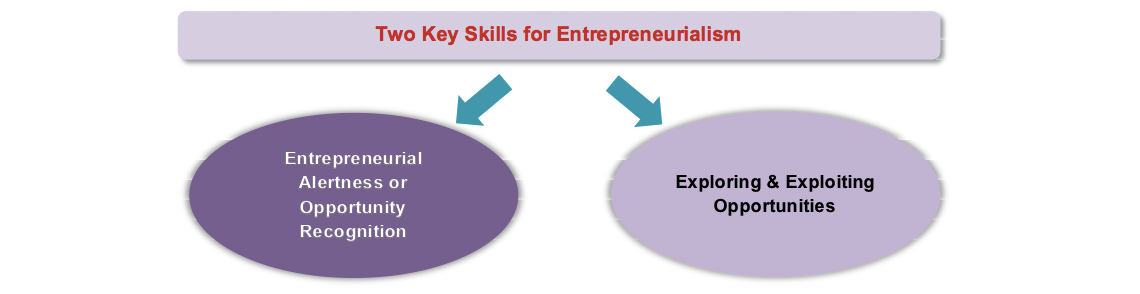
Entrepreneurial Alertness or Opportunity Recognition. This entrepreneurial skill is about identifying a profit-making opportunity based on potential product or service that is not available in the market. This skill is gained through entrepreneurial experiences. Some ways in which you can enhance your entrepreneurial alertness or opportunity recognition are:
- Immersing yourself in entrepreneurial ventures
- Learning through the experiences of successful entrepreneurs
- Reflecting on your experiences.
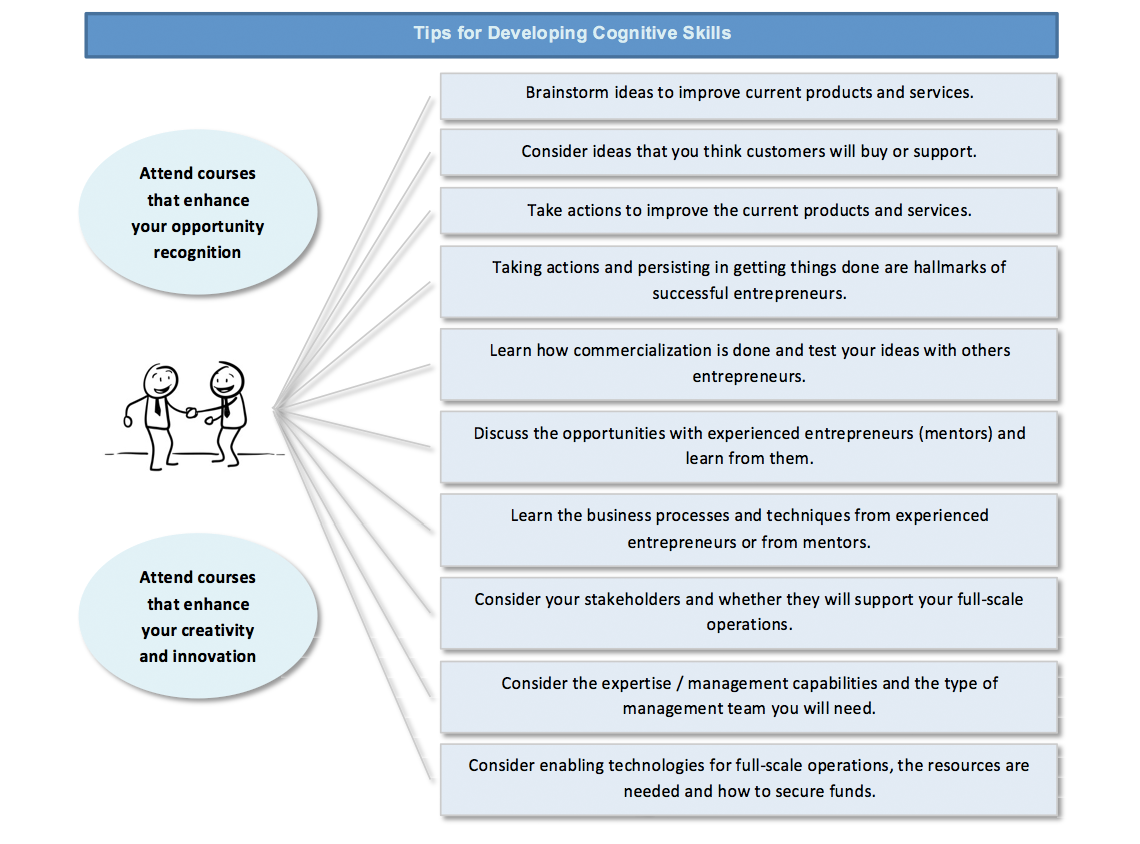
Exploring & Exploiting Opportunities. You could also practice the behaviours or cognitive skills of successful entrepreneurs. One way is to learn how to explore and exploit opportunities after you recognise the opportunity. You can practice this skill if you:
- believe that others (customers) will value your new product/idea
- believe you have the enabling technologies for full-scale operations
- believe you have a capable team who can help you operationalise the idea
- believe you have strong stakeholder support for the full-scale operations.
Enabling or Supporting Skills for Entrepreneurialism
These are leadership or influence skills. Attend workshops or programs that can help you develop the following skills that support your entrepreneurialism:
- Envisioning and selling your vision to others
- Presentation or Communication skills
- Networking skills
- Cross-cultural awareness and cultural competence
Starting Your Entrepreneurial Learning
Make use of your internship assignments to gain entrepreneurial experiences.
- Ask questions and learn.
- Do not be afraid to make mistakes. When you do, learn from them. Develop a positive frame of mind.
- While in your internship program, create a portfolio of your E development including the skills that you have acquired, and record your reflections and learning. A simple format for the portfolio can include the following sub-headings:
- Short description of my internship roles/responsibilities
- List of my entrepreneurial skills
- My confidence on the above skills before and after my internship
- Description of relevant internship experiences/episodes where skills were learnt
- My reflections & learning.
Your Continual Learning as an Entrepreneur
To remain entrepreneurial and be a successful entrepreneur, it is imperative to continue your learning. Some ways in which you can continually develop yourself as an entrepreneur include:
- Reading books, articles, blogs, podcasts, TED talks etc. on:
- Stories of successful entrepreneurs
- Creativity and innovation in business
- Boundary spanning in entrepreneurship
- Latest ideas in business and technology.
- Networking with other entrepreneurs and attend relevant conferences.
- Learning organizational leadership skills.
- Joining a mentoring program that helps young entrepreneurs learn.
References
Baron, R. A. (2004, August). Opportunity Recognition: A Cognitive Perspective. In Academy of Management Proceedings (Vol. 2004, No. 1, pp. A1-A6). Academy of Management.
Brandstätter, H. (2011). Personality aspects of entrepreneurship: A look at five meta-analyses. Personality and individual differences, 51(3), 222-230.
Chan, K. Y., Uy, M. A., Chernyshenko, O. S., Ho, M. H. R., & Sam, Y. L. (2015). Personality and entrepreneurial, professional and leadership motivations. Personality and Individual Differences, 77, 161-166.
Choi, Y. R., & Shepherd, D. A. (2004). Entrepreneurs’ decisions to exploit opportunities. Journal of Management, 30(3), 377-395.
Ciavarella, M. A., Buchholtz, A. K., Riordan, C. M., Gatewood, R. D., & Stokes, G. S. (2004). The Big Five and venture survival: Is there a linkage? Journal of Business Venturing, 19(4), 465-483.
Giones, F., Zhou, Z., Miralles, F., & Katzy, B. R. (2013). From ideas to opportunities: Exploring the construction of technology-based entrepreneurial opportunities. Technology Innovation Management Review, June.
Ofstein, L. F. & Shrader, R. (2013). Boundary Spanning In The Entrepreneurial Firm: Effects On Innovation And Firm Performance (Interactive Paper). Frontiers Of Entrepreneurship Research, 33, (11). Available At: http://Digitalknowledge.Babson.Edu/Fer/Vol33/Iss11/14
Uy, M. A., Chan, K. Y., Sam, Y. L., Ho, M. H. R., & Chernyshenko, O. S. (2015). Proactivity, adaptability and boundaryless career attitudes: The mediating role of entrepreneurial alertness. Journal of Vocational Behavior, 86, 115-123.
Zhao, H., & Seibert, S. E. (2006). The big five personality dimensions and entrepreneurial status: a meta-analytical review. Journal of Applied Psychology, 91(2), 259.